Ether
- Contain an oxygen atom in the middle of two carbon chains
- Name by lowest number of carbons to highest
- functional group is "O" and ends in "ether"
Aldehydes
- An aldehyde is a compound that has a double bonded oxygen at the end of a chain
- The simplest aldehyde is methanal (also called formaldehyde)
- ends in -al
Carboxylic Acids
- Carboxylic acids are formed by the function group O=C-OH
- Use standard rules but change the parent chain ending to -oic acid
- The simplest carboxylic acid is methanoic acid
Esters
- Carbon chain separated by an oxygen
- Has double bonded oxygen
- ends in - oate
- Naming starts with carbon chain without double bonded oxygen
Nitro
- Standard naming rules
- Nitro in front of parent chain
- functional group : NO2
Amine
- Function group : N
- Separates carbon chains
- numbering starts from N & goes in alphabetical order
- ends in Amine
- bonded to either hydrogen or carbon
- Primary amines = 1 carbon chain
- Secondary amines = 2 carbon chains
- Tertiary amines = 3 carbon chains
Amides
- Functional group : O=C-N
- ends in -amide
- NH2 starts with double bonded oxygen
- JanCarlo Paysan
Tuesday, 22 May 2012

Aromatics
- Benzene (C6H6) is a cyclic hydrocarbon with unique bonds between the carbon atoms
- Structurally it can be drawn with alternating double bonds
- Careful analysis shows that all 6 C-C bonds are identical and really represent a 1.5 bond
- This is due to electron resistance
- electrons are free to move all around the ring
Aromatic Nomenclature
- A Benzene molecule is given a special diagram to show it's unique bond structure
- Benzene can be a parent chain or a side chain
- As a side chain it is given the name phenyl
- JanCarlo Paysan
Organic Chemistry
Nomenclature
- Organic chemistry is the study of Carbon compounds
- Carbon forms multiple covalent bonds
- Carbon compounds can form chains, rins, or branches
- there are less than 100 000 non-organic compounds
- organic compounds number more than 17 000 000
- The simplest organic compounds are made of carbon and hydrogen
- Saturated compounds have no double or triple bonds
- Compounds with only single bonds are called alkanes and always end in -ane
- Isomer-two or more compounds with the same empirical formulas
- There are three categories of organic compounds
- Straight Chains
- rules for naming chain compounds
- Circle the longest continuous chain and name this as the base chain -meth ,eth ,prop...
- Number the base chain so side chains have the lowest possible numbers
- Give each side chain using the -yl ending
- Give each side chain the appropriate number
- if there is more than one identical side chain numbers are slightly different
- List side chains alphabetically
- Cyclic Chains
- Aromatics
- JanCarlo Paysan
Monday, 21 May 2012
Alicyclics
 |
| cyclopentane |
-Are single carbon bonds formed into a loop
-Prefix to name these kind of bonds are cyclo- (ex:cyclobutane)
-Side chains may also be alicyclic (ex: cyclobutyl)
-Paul Dinh
Halides
-Halides consists of F, Cl, Br, I.
-Are always side chains connected to carbon atoms
- When part of naming, Flourine would be Floro, Chlorine would be Chloro, Bromine would be Bromo, and Iodine would be Iodo. (ex: 1 floro 1 chloro 1 bromo 1 iodo methane)
-Paul Dinh
-Are always side chains connected to carbon atoms
- When part of naming, Flourine would be Floro, Chlorine would be Chloro, Bromine would be Bromo, and Iodine would be Iodo. (ex: 1 floro 1 chloro 1 bromo 1 iodo methane)
-Paul Dinh
Alcohols and Ketones
Alcohols
-An alcohol is a part of the hydroxyl group
-Has an -OH on the end of the parent chain
- Follows the same nomenclature rules as other groups
-End in -ol (ex: ethanol)
Ketones
-A ketone is a part of the carbonyl group (carbon to oxygen)
-Has a double bond -O as a side chain from the parent group but never on the ends.
-Ends in -none (ex: butanone)
-Paul Dinh
Alkene(dbl bond) and Alkynes (triple bond)
 |
| Double bond (alkenes) |
- When multiple bonds form fewer hydrogens are attached to the Carbon atom
- The position of the double/ triple bonds will always have the lowest number
- double bonds alkenes end in -ene
- triple bonds end in -yne
 |
| Triple bond (alkynes) |
-Paul Dinh
Monday, 16 April 2012
Intermolecular Bonds
Types of Bonds
- Intramolecular bonds
- exist within a molecule
- ionic, covalent
- Intermolecular bonds exist between molecules
- The stronger the intermolecular bonds the higher the boiling point or melting point
- Two types of Intermolecular : Van der Waals Bonds and Hydrogen bonds
Van der Waals Bonds
- Based on electron distribution
- Two categories
1) Dipole - Dipole bonds
- If a molecule is polar the positive end of one molecule will be attracted to the negative end of another molecule
2) London Dispersion Forces (LDF)
- LDF is present in all molecules
- creates weakest bonds
- if a substance is non-polar dipole-dipole forces don't exist
- Electrons are free to move around and will randomly be grouped on one side of the molecule
- This creates a temporary dipole and can cause a weak bond to form
- The more electrons in the molecule the stronger the LDF can be
Hydrogen Bonding
- If Hydrogen is bonded to certain elements (F, O, or N) the bond is highly polar
- This forms a very strong intermolecular bond
Effects of Bonds
- Melting and boiling points are a measure of intermolecular bond strength
- JanCarlo Paysan
Polar Molecules
Polar Molecules
- Polar molecules have an overall charge separation
- Unsymmetrical molecules are usually polar
- Molecular dipoles are the result of unequal sharing of electrons in a molecule
Predicting Polarity
- If a molecule is symmetrical the pull of electrons is usually balanced
- Molecules can be unsymmetrical in two ways
- different atoms
- different number of atoms
- JanCarlo Paysan
Bonding
Bonds & Electronegativity
Types of Bonds
- There are 3 main types of bonds:
1) Ionic (metal - non metal)
- electrons are transferred from metal to non metal
2) Covalent (non metal - non metal)
- electrons are shared between non metals
3) Metallic (metal)
- holds pure metals together by electrostatic attraction
Electro Negativity
- Electro negativity (en) is a measure of an atom's attraction for electrons in a bond
- Atoms with a greater en attract electrons more
- Polar Covalent bonds form from an unequal sharing of electrons
- Non-Polar Covalent bonds form from equal sharing
Bonds
- The type of bond formed can be predicted by looking at the difference in electronegativity of the elements
- en > 1.7 = ionic bond
- en < 1.7 = polar covalent bond
- en = 0 = non polar covalent bond
- Jan Carlo Paysan
Wednesday, 14 March 2012
Ion Concentration
Dissociation
-Ionic compounds are made up of 2 parts:
→Cation: positively charged particle
→Anion: negatively charged particle
-When ionic compounds are dissolved in water the cation & anion separate from eachother
-This process is called dissociation
-When writing dissociation equations, the atoms & charges must balance.
The dissociation of Sodium Chloride is:
NaCl(s) → Na+(aq) = Cl-(aq)
*have to write charges*
-Paulo Santillan
Dilutions
Diluting Solutions
-When 2 solutions are mixed the concentration changes
-Dilution is the process of the decreasing the concentration by adding a solvent (usually water)
-The amount of solute does not change
n1 = n2
C1V2 = C2V2
-Because concentration is mol/L we can write:
C = n/v
&
n = CV → mol/L x L = mol
so
C1V1 = C2V2
-EXAMPLE
-Determine the concentration when 100ml of 0.10M of HCL is diluted to a final volume of 400ml.
V2= 400mL
V1= 100mL
C1= 0.10M
C2= ?
C1V1 = C2V2
C1V1 / V2 = C2
(100)(0.1) / (400) = C2
C2 = 0.025M
-Paulo Santillan
Titrations
-A titration is an experimental technique used to determine the concentration of an unknown solution

Terms and Equipment
-Buret: contains the known solution. Used to measure how much is added
-Stopcock: Valve used to control the flow of the solution from the Buret
-Pipet: Used to accurately measure the volume of the unknown solution
-Erlenmeyer Flask: Container for unknown solution
-Indicator: Used to identify the end point of the titration
-Stock Solution: Known solution
-Paulo Santillan
Solution Stoichiometry
Solutions
- Solutions are homogenous mixtures composed of a solute and a solvent
- solute is the chemical present in the lesser amount (whatever is dissolved)
- solvent is the chemical present in the greater amount (whatever is dissolving)
- Chemicals dissolved in water are aqueous
NaCl(s) --H20--> NaCl(aq) : to show something dissolved by water
Molarity
- Concentration can be expressed in many different ways
- g/L, mL/L, % by volume, % by mass, mol/L
- The most common ( in Chem 11/12) is mol/L which is also called Molarity
- mol/L = M
- [HCl] = concentration of HCl
- JanCarlo Paysan
Limiting Reactants
- In chemical reactions, usually one chemical gets used up before the other
- the chemical used up first is called the limiting reactant
- once it is used up the reaction stops
- L.R. Determines the quantity of products formed
- To find the L.R. assume one reactant is used up. Determine how much of this reactant is required
ex. 2.5 mol of CuSO4 reacts with 2.5 mol of NaNO3. Determine the L.R. and calculate how many moles of Na2SO4 are formed
CuSO4 + 2NaNO3 -> Na2SO4 + Cu(NO3)2
2.5 mol * 2/1 = 5 mol of NaNO3 needed
2.5 mol * 1/2 = 1.25 mol of CuSO4 needed
- NaNO3 is the L.R.
- JanCarlo Paysan
Wednesday, 8 February 2012
Percent Yield
-The theoretical yield of a reaction is the amount of products that SHOULD be formed.
-The actual amount depends on the experiment.
-The percent yield is like a measure of success
-The actual amount depends on the experiment.
-The percent yield is like a measure of success
- How close is the actual amount to the predicted amount?
% Yield = Actual
% Yield = Actual
Theoretical x 100
Evergy & Percent Yield
-Enthalpy is the energy stored in chemical bonds
-Symbol of Enthalpy is H
- units of joules (J)
- Change in Enthalpy is ΔH
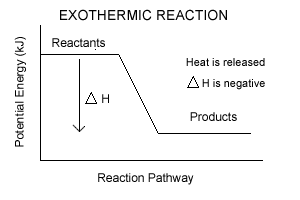
- In exothermic rxns enthalpy decreases
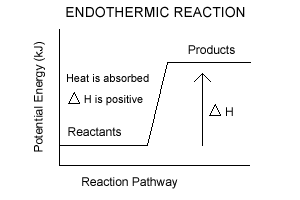
-In endothermic rxns enthalpy increases


Calorimetry
- To experimentally determine the heat released we need to know 3 things
1) temperature change ( ΔT)
2) Mass (m)
3) specific Heat capacity (c)
There are related by the equation: ΔH = mC ΔT
ex: calculate the heat required to warm a cup of 400g of water (C= 4.18J/g °C) from 20.0 °C to 50.0 °C.
ΔH=mCΔT
ΔH= (400)(4.18)(50.0-20.0)
ΔH=50160 J = 50.2 kJ
-Paul Dinh
-Symbol of Enthalpy is H
- units of joules (J)
- Change in Enthalpy is ΔH
- In exothermic rxns enthalpy decreases
-In endothermic rxns enthalpy increases
Calorimetry
- To experimentally determine the heat released we need to know 3 things
1) temperature change ( ΔT)
2) Mass (m)
3) specific Heat capacity (c)
There are related by the equation: ΔH = mC ΔT
ex: calculate the heat required to warm a cup of 400g of water (C= 4.18J/g °C) from 20.0 °C to 50.0 °C.
ΔH=mCΔT
ΔH= (400)(4.18)(50.0-20.0)
ΔH=50160 J = 50.2 kJ
-Paul Dinh
Other Conversions : Volume & Heat
-Volume at STP can be found using this conversion factor 22.4 L/mol
-Heat can be included as a separate terms in chemical reactions (This is called Enthalpy)
-Rxns that release heat are exothermic
-Rxns that absorb heat are endothermic
-Both can be used in stoichiometry
ex: If 5.0 g of Potassium chlorate decompose according to the reaction below, what volume of Oxygen gas (at STP) is produced?
2KClO3 > 2KCL + 3O2
5.0 g x 1mol/122.6 g x 3/2 x 22.4 L/ 1 mol = 1.4 L of Oxygen
ex2: When Zinc reacts with hydrochloric acid exactly 1.00 L of hydrogen gas is produced (at STP). What mass of Zinc was reacted?
Zn +2HCl > ZnCl2 + H2
1.00 L x 1mol/22.4 x 1/1 x 65.4 g / 1 mol = 2.92 g of Zinc
- Paul Dinh
Mass to Mass Conversions
mass to mass problems are additional conversions.
Grams of A Grams of B
| |
Moles of A - >>Multiplied boy the stoichiometric ratio >>> Moles of B
ex: lead (IV) nitrate reacts with 5.0 g of Pottasium iodide. How many grams of lead (IV) nitrate are required for a complete reaction?
Pb (NO3)4 + 4KI > 4KNO3 = PbI4
5.0g x (1 mole over 166 g/mol) x 1/4 x (455 over 1 mole) = 3.4 g
ex2: how many grams of O2 are produced ffrom the decomposition of 3.og of Pottasium chlorate?
2KClO3 >> @K + Cl2 + 3O2
3.0 g x (1 mole over 122.6 g x 3/2 x (32 over 1 mol) = 1.2 g
-Paul Dinh
Monday, 6 February 2012
Mole to Mass & Mass to Mole
ex How many grams of Bauxite (Al2O3) are required to produce 3.5mol of pure aluminum?
Step 1 - Write a balanced equation (2Al2O3 - > 4Al + 3O2)
Step 2 - Change moles of aluminum to moles of bauxite using "what you need over what you have" (2/4)
Step 3 - Multiply the moles of bauxite by the molar mass of bauxite (1.75mol * 102g/mol)
=1.8*10^2g of bauxite
How many moles of Lead(II)Nitrate are consumed when 4.5g of sodium sulphide completely react?
Step 1 - Write a balanced equation (Pb(NO3)2 + Na2S -> PbS + 2NaNO3)
Step 2 - Change grams of sodium sulphide to moles using molar mass ( 4.5/78.1)
Step 3 - Change moles of sodium sulphide to moles of Lead(II)Nitrate using "what you need over what you have" (1/1)
= 0.058mol of Lead(II)Nitrate
- JanCarlo Paysan
- JanCarlo Paysan
Subscribe to:
Posts (Atom)